


Every social media platform can change its algorithm tomorrow and cut your organic reach in half. Every search engine can update its ranking signals and drop your content from the first page. Every advertising platform can increase its prices until your return on ad spend is no longer viable. None of these things can happen to your email list.
Your email list belongs to you. A subscriber who has given you their email address has made an explicit choice to hear from you. That relationship – a direct, unmediated connection to someone who is interested in what you do – is the most valuable digital asset a small business can build. And email marketing consistently delivers the highest return on investment of any digital marketing channel, with industry benchmarks showing around €36 back for every €1 spent.
This guide covers how to build an email list from scratch, how to grow it with the right subscribers, and how to write emails that people actually open and act on.
Why Email Marketing Outperforms Other Channels
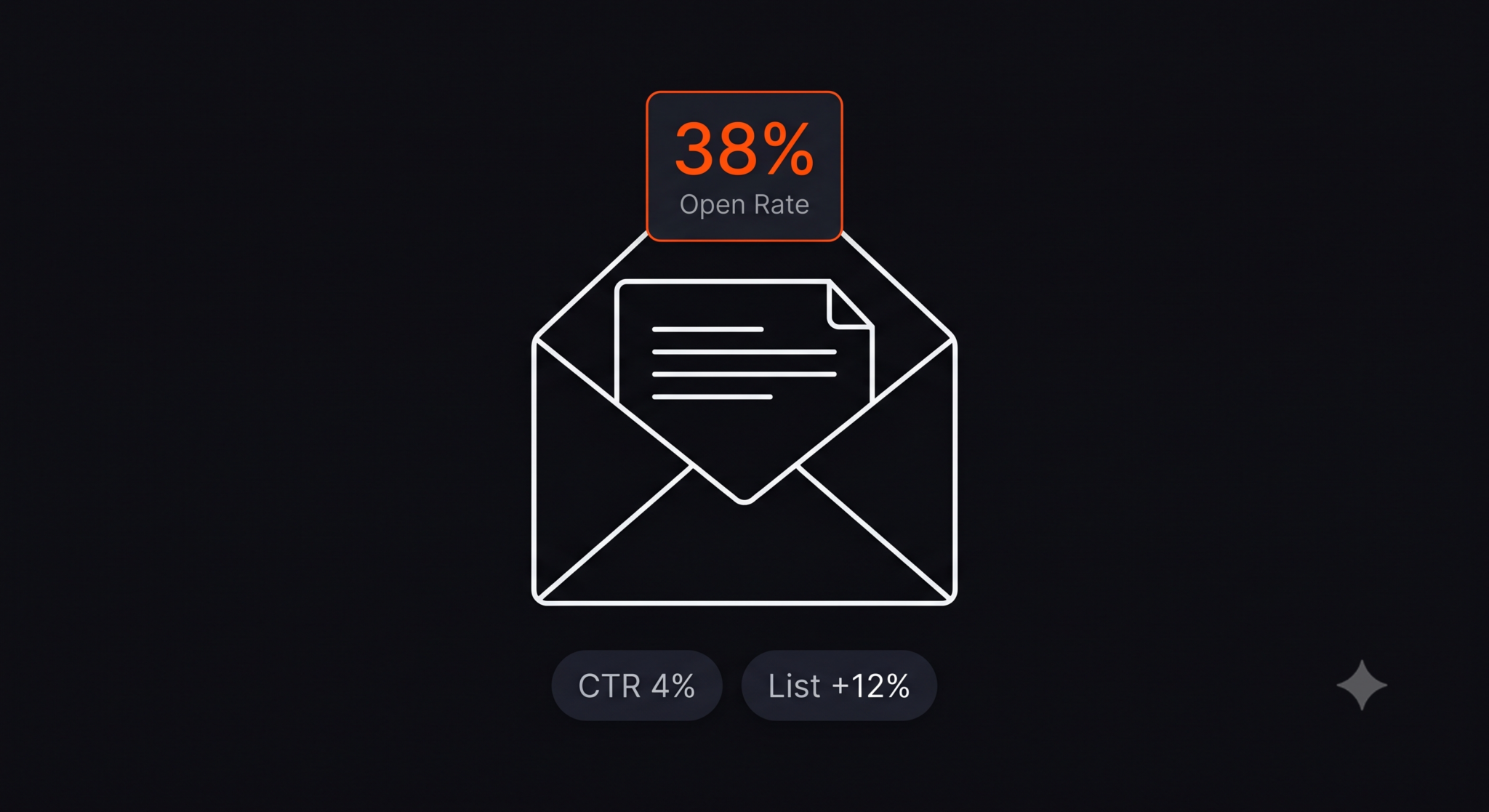
The numbers on email marketing consistently surprise people who assume it has been replaced by social media or content marketing. Email open rates for small business newsletters typically run between twenty and forty percent – meaning one in three or four subscribers sees every message. Compare this to organic social media reach, which on most platforms is now between one and five percent of your followers.
Email also reaches people in a different mode. A social media post is encountered while scrolling – one piece of content among hundreds competing for a moment of attention. An email arrives in a personal inbox and is considered individually. When someone opens your email, they have made an active choice to give you their attention. That is a fundamentally different relationship than a social media impression.
How to Build an Email List From Scratch
Step 1: Choose your email platform
Before you can collect subscribers, you need a platform to manage them. For small businesses starting out, the choice comes down to two options that offer genuinely useful free tiers: Mailchimp (free up to 500 contacts and 1,000 emails per month) and Brevo (free up to unlimited contacts and 300 emails per day). Both include list management, email templates, basic automation, and analytics. Mailchimp has a wider integration ecosystem; Brevo has a more favourable pricing model as your list grows past 2,000 contacts.
Step 2: Create a reason to subscribe
“Subscribe to our newsletter” is not a compelling reason to give someone your email address. You need to offer something specific and valuable in exchange. The most effective email list growth mechanisms are lead magnets – a specific, immediately useful resource that someone can download or access in exchange for their email address.
Effective lead magnets for small businesses include: a practical template or checklist directly relevant to your customer’s work, a short guide that answers a question your customer is actively searching for, a free tool or calculator that helps them solve a specific problem, or access to a resource library of useful materials. The lead magnet should be something your ideal customer finds genuinely useful – not a promotional document dressed up as helpful content.
Step 3: Put the signup form where people will see it
The best lead magnet in the world produces zero subscribers if the signup form is buried at the bottom of an about page that no one visits. Place your email signup form in at least three locations: at the top of your website homepage (above the fold if possible), at the end of every blog article, and as an exit-intent popup or persistent bar that appears when visitors show signs of leaving. Each additional visible placement increases your list growth rate without requiring any additional traffic.
Step 4: Import your existing contacts
Most businesses already have email relationships that have not been formalised into a list. Past clients. Current clients. Enquiries that did not convert. Professional contacts who have expressed interest in your work. With appropriate permission – and in compliance with GDPR, which requires a legitimate basis for contact – these contacts can be imported into your email platform as a warm starting audience. A list of fifty people who already know and trust you is worth more than five hundred cold subscribers who found you through a promotion.
How to Write Emails People Actually Open
The subject line decides everything
Your subject line is the single most important element of your email. It determines whether the email gets opened or ignored. Research consistently shows that subject lines perform best when they are specific, relevant to the reader’s situation, and create genuine curiosity without resorting to clickbait. Short subject lines (four to seven words) typically outperform long ones. Personalisation (using the recipient’s first name) helps in some contexts but is not universally effective.
Subject lines that perform well tend to be either specific and useful (“Three things to check before your Q3 planning session”), directly relevant to a current challenge (“If your marketing feels disconnected, this is why”), or personal and honest (“I made a mistake last month – here is what I learned”). Subject lines that perform poorly tend to be vague (“Our latest newsletter”), self-promotional (“Exciting news from [Company]”), or try to fake urgency (“Last chance!”).
The first sentence determines whether they keep reading
Once the email is opened, the first sentence – visible in the preview pane and at the top of the email body – determines whether the reader continues or stops. Do not open with pleasantries, company updates, or context-setting. Open with something that immediately signals value, creates curiosity, or speaks directly to a situation the reader recognises. The first sentence should make someone want to read the second sentence.
One email, one purpose
The most common email marketing mistake after the subject line is trying to accomplish too much in one email. An email that includes a company update, a new blog post, a product announcement, an event invitation, and a survey is an email that accomplishes none of these things effectively. Decide on one purpose for each email and structure everything around that purpose. One email, one clear action you want the reader to take.
Write like a person, not a brand
The emails with the highest open and click rates are typically those that feel personal – written by a real person to another real person, not produced by a marketing department for a target demographic. Use first person. Use conversational language. Share something real – a genuine observation, a question you have been thinking about, a mistake you made and what you learned from it. The newsletter that reads like a letter from a knowledgeable friend consistently outperforms the polished corporate newsletter.
Email Frequency and Consistency
How often should you email your list? The honest answer is: more often than most small businesses do, but with strict quality control. The most common email marketing failure is not over-sending – it is inconsistency. A business that emails its list once, then goes quiet for two months, then sends a promotional email has not built a relationship; it has exploited one when it needed something.
A practical framework for small businesses: a minimum of one email per month is required to maintain list warmth. Two emails per month is the recommended starting cadence for most businesses. Weekly is appropriate if you consistently have something genuinely useful to share. The frequency that works best is the one you can maintain with quality content indefinitely.
The Welcome Email – Your Most Important Email
The email with the highest open rate in any email marketing program is the welcome email – the first email a new subscriber receives after joining your list. Open rates for welcome emails regularly exceed seventy to eighty percent. This makes it by far the most valuable email you will ever send, and yet most businesses either send a generic automated confirmation or nothing at all.
Your welcome email should: deliver the lead magnet you promised (if applicable), introduce yourself and what to expect from your emails, demonstrate immediate value by sharing something genuinely useful, and set expectations for frequency and content. Think of it as your first real conversation with a new contact who has chosen to hear from you – use it.
Measuring Email Marketing Performance
Four metrics tell you most of what you need to know about your email marketing performance.
Open rate tells you whether your subject lines and sender reputation are working. Industry average for small business newsletters is around twenty-five to thirty percent. Below twenty percent suggests a subject line or deliverability problem. Above forty percent suggests your audience is highly engaged.
Click-through rate tells you whether the content and call to action are compelling. Average click rates are typically two to five percent. Low click rates with high open rates suggest good subject lines but weak content or unclear calls to action.
Unsubscribe rate is the signal that you are either emailing too frequently or delivering content that does not match subscriber expectations. A healthy unsubscribe rate is below zero point five percent per email. Higher rates indicate a mismatch between what you promised and what you are delivering.
List growth rate – how quickly your list is growing net of unsubscribes – tells you whether your lead generation mechanisms are working. A list that is not growing is slowly becoming less valuable as contacts disengage over time.
GDPR and Finnish Email Marketing Law
In Finland, as across the EU, email marketing is governed by GDPR and the Finnish Act on Electronic Communications Services. The practical requirements for small businesses are straightforward: you need a legitimate legal basis for sending marketing emails (typically explicit consent), you must make it easy to unsubscribe from every email, you must not purchase email lists, and you must store contact data securely. All major email platforms (Mailchimp, Brevo, etc.) include unsubscribe functionality automatically and help you comply with these requirements.
Email Marketing and Target
Email marketing at its most effective is connected to everything else in your marketing: the customer personas that tell you what topics matter to your audience, the content calendar that ensures you have something to say every time you send, and the brand guidelines that keep every email consistent with how you look and sound everywhere else.
Target brings all of these layers into one place – so your email marketing is not a separate activity but a natural extension of a coherent marketing strategy.
See the plans and get started today.